5 Core Strategies
Every successful multi-kid homeschool uses some combination of these approaches. You don't need all five — pick the ones that match your family's style.
The Rotation Method
Cycle through kids every 20-30 minutes giving focused attention to one while others work independently. A per-child task list makes this work because nobody needs to ask "what do I do next?"
Anchor Subjects Together
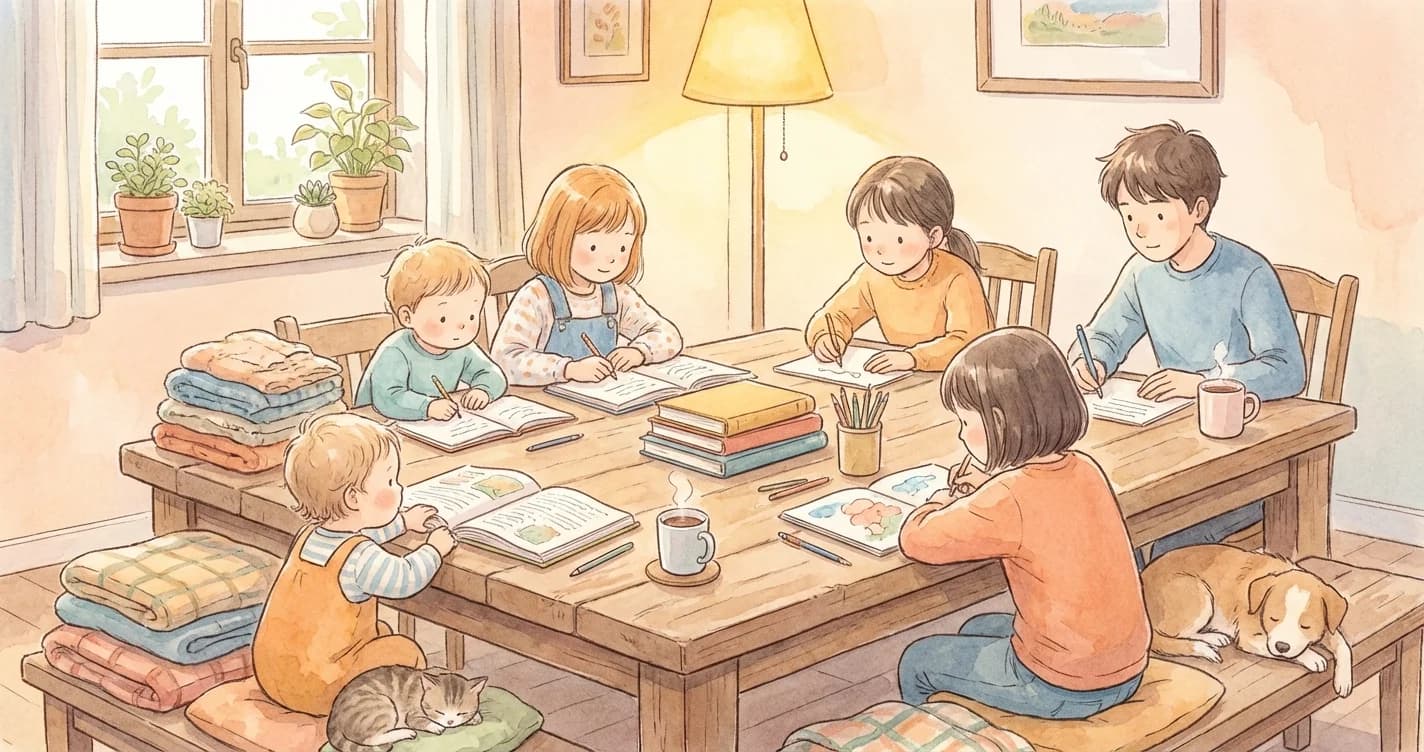
History, science, art, music, and read-alouds can be done as a group. Adapt the output: a 6-year-old draws about the topic, a 12-year-old writes a summary. Same lesson, different assessment.
Stagger Start Times
Oldest starts math at 8:30 independently. You start with youngest at 9:00. Middle child starts independent reading at 8:30, switches to math with you at 9:30. Nobody waits.
Buddy System
Pair an older child with a younger one for certain activities. The older child reinforces their knowledge by teaching. The younger child gets peer interaction. Win-win.
Task Tracker Independence
Give each child a daily task list they can check off themselves. "Complete math lesson 14" not "do math." When they can see their tasks, they can self-pace without constant direction.
Sample Schedules by Family Size
2-Kid Family (Close Ages)
Ages within 2-3 years of each other
Math (independent, different levels)
Both work simultaneously
Language Arts (switch focus)
Help one while other reads
Break + quick chore
10 min movement reset
History/Science (together)
Same topic, different output
Read-aloud + art
Combined activity
Lunch + chores
Both contribute
3-Kid Family (Mixed Ages)
Wide age spread (e.g., 5, 8, 12)
Oldest: independent math / Middle: phonics with parent / Youngest: play-based learning
Rotation starts
Oldest: reading / Middle: independent math / Youngest: with parent
Rotate focus
All: science experiment or nature walk
Combined - all ages participate
Break + chores (assigned per age)
Movement + responsibility
Oldest: essay / Middle: writing practice / Youngest: art
Independent work
Read-aloud (all together)
Family bonding + literacy
Lunch + afternoon activities
Youngest done for the day
4+ Kid Family
Large family with multiple grades
Morning chores (everyone)
Sets the tone for the day
Block A: Older kids independent / Younger kids with parent
45-min rotation
Block B: Swap - older get parent time, younger do workbooks
Structured independence
All: Combined subject (history, science, art)
Everyone participates at their level
Skill blocks (each child at their level)
Use task tracker for self-pacing
Lunch + midday chores
Rotate kitchen duty
Independent projects / electives / PE
Older kids self-direct
Common Pitfalls
Trying to teach every subject separately for each child
Fix: Combine 60% of subjects. Only separate math and reading level.
No independent work expectations
Fix: Even 5-year-olds can do 15 minutes alone with the right tasks. Build up gradually.
Everyone starts and stops at the same time
Fix: Stagger start times. Older kids can begin independently while you help younger ones.
No task tracking system
Fix: Each child needs their own daily list. A shared board or app so they don't ask "what's next?" every 5 minutes.
Ignoring chores in the school day
Fix: Short chore breaks between subjects give movement and teach responsibility. Build them into the schedule.